Oct 18th 2025
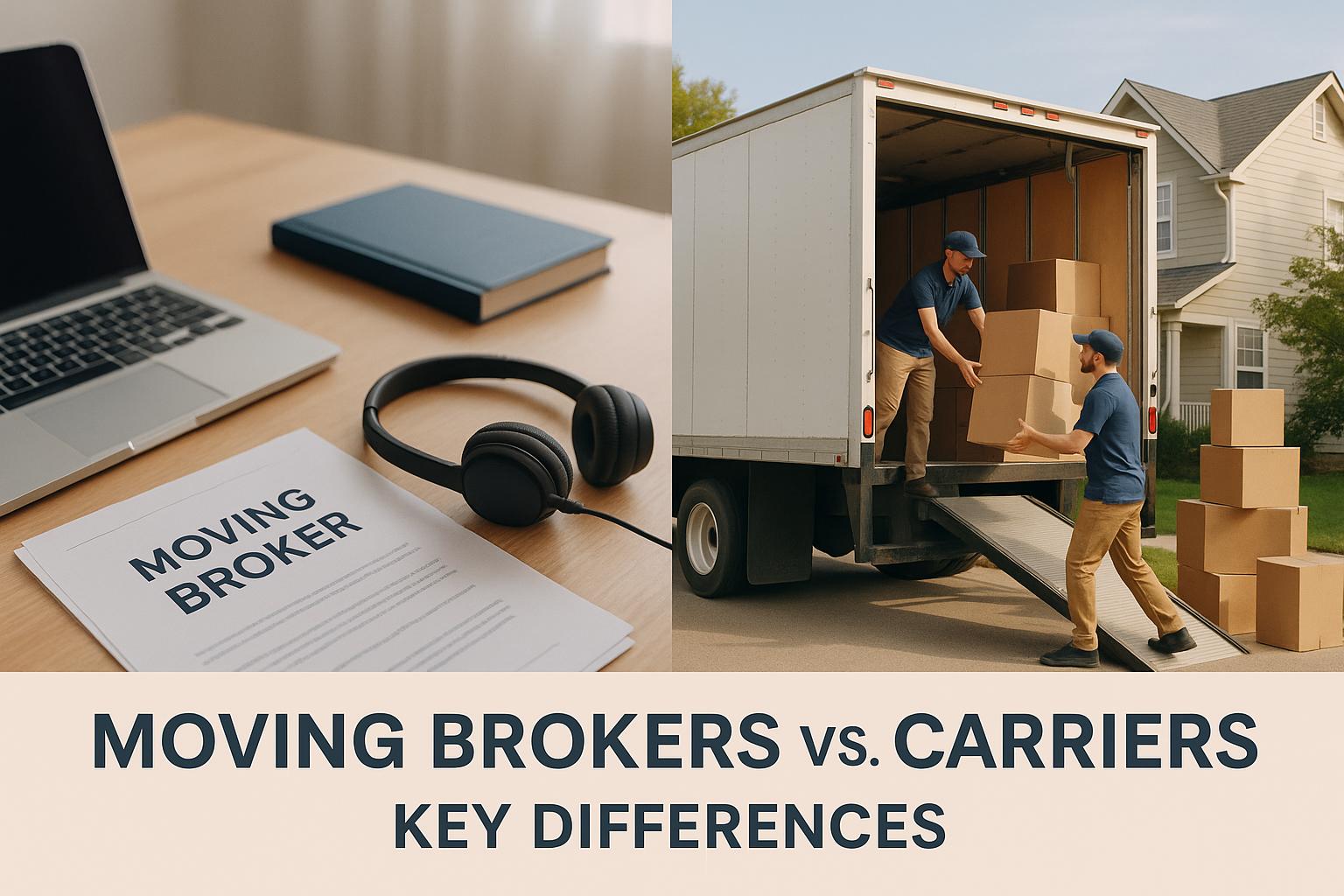
Moving Brokers vs. Carriers: Key Differences
When planning a move, understanding the difference between moving brokers and moving carriers is crucial. Here’s a quick breakdown:
- Moving Brokers: Act as middlemen. They don’t own trucks or employ movers but connect you with licensed carriers. They offer broader network access and often competitive pricing but may lack accountability and transparency.
- Moving Carriers: Handle your move directly. They own trucks, employ crews, and manage every step of the process. They provide consistent service, transparent pricing, and clearer accountability but may have limited availability.
Quick Comparison
| Feature | Moving Brokers | Moving Carriers |
|---|---|---|
| Own trucks and crews | No | Yes |
| Direct service | No (outsourced to carriers) | Yes |
| Pricing | Competitive but less transparent | More straightforward |
| Accountability | Indirect | Direct |
| Availability | High (large network) | Limited by fleet capacity |
To choose the right option, consider your budget, timeline, and need for control over the process. Brokers are ideal for flexibility and last-minute moves, while carriers are better for reliability and clear communication.
I Wish I Knew: Movers vs Brokers
What Are Moving Brokers?
A moving broker is essentially a middleman in the moving industry. They don’t own trucks, employ movers, or physically handle your belongings. Instead, they act as coordinators, connecting customers with licensed moving carriers from their network - think of them as travel agents for your move. For interstate moves, brokers must register with the Federal Motor Carrier Safety Administration (FMCSA). However, unlike moving carriers who physically transport your household goods, brokers are limited to arranging and managing the logistics of the move[2][3].
How Moving Brokers Work
The process kicks off when you request a moving quote. The broker gathers details about your move - such as pickup and delivery addresses, the size of your inventory, and any special requirements - and provides an estimate. If you accept the quote, the broker assigns a licensed carrier from their network to handle the move[2][3].
It’s important to note that the company providing the quote is often not the one transporting your belongings. While the broker takes care of logistics and scheduling, the actual work - like packing, loading, and transporting - is performed by the assigned carrier. For instance, a company like Moving Ease uses its network to offer tailored moving packages. They arrange services such as full-service packing or storage, but the execution is handled by the carrier they assign.
The main benefit of working with a broker is their ability to quickly connect you with available carriers and potentially secure competitive pricing. However, this setup also means you have less control over which company ends up managing your move. This structure brings both advantages and challenges that can affect your overall experience.
Moving Broker Advantages and Disadvantages
Using a moving broker has its upsides and downsides, and understanding these can help you decide if this option is right for you.
| Advantages | Disadvantages |
|---|---|
| Wide Network Access – Brokers can connect you with a broad range of moving companies, providing extensive coverage and availability. | Limited Accountability – Since brokers don’t handle your belongings directly, resolving disputes or claims can become complicated. |
| Competitive Pricing – By accessing multiple carriers, brokers can secure competitive bids, which might result in lower initial quotes. | Risk of Hidden Fees – Initial quotes are often non-binding, and costs can rise after the carrier evaluates your actual inventory. |
| Quick Booking – Their large networks make it easier to schedule moves quickly, which is especially helpful for last-minute relocations. | Inconsistent Service Quality – There’s a chance you’ll be paired with carriers that haven’t been thoroughly vetted, leading to unpredictable service. |
| Streamlined Process – Brokers handle the logistics of finding and coordinating with carriers, making the booking process simpler. | Lack of Transparency – Some brokers may “auction off” jobs to the lowest bidder, prioritizing cost over service quality. |
The biggest draw of using a broker is their vast network, which can be especially helpful if you’re moving to or from a less-serviced area or need to arrange a move on short notice.
However, there are risks to consider, particularly around accountability and pricing transparency. Since brokers don’t directly manage your belongings, resolving issues can be tricky, often leaving you stuck between the broker and the carrier. Be wary of brokers offering unusually low quotes - they often increase significantly once the carrier evaluates the details of your move[2][3]. Additionally, the FMCSA has reported a rise in consumer complaints about brokers failing to properly vet their carrier partners. This can lead to inconsistent service quality and, in some cases, scams[2].
What Are Moving Carriers?
A moving carrier is a company that takes care of your entire move using its own trucks, equipment, and team. Unlike brokers, who act as middlemen and subcontract the work to other companies, carriers handle everything directly - from packing and loading to transportation and unloading. This means you’ll have a single point of contact and clear accountability throughout your move.
These companies are registered with the Federal Motor Carrier Safety Administration (FMCSA) and must meet strict safety, insurance, and operational standards. When you hire a carrier, you’re working directly with the people responsible for moving your belongings - no third parties involved.
How Moving Carriers Work
Here’s how moving carriers operate: When you request a quote, their team evaluates your needs and provides an estimate. Since the carrier handles every part of the process, pricing is usually more straightforward and less prone to hidden fees.
Once you book, a move coordinator is typically assigned to guide you through the entire relocation. The carrier sends its own crew and trucks, ensuring they maintain full control and communication throughout.
"Amerisafe Van Lines, for instance, maintains full oversight from quote through delivery."
- Amerisafe Van Lines
Carriers are legally responsible for your belongings during transport and must offer valuation coverage as required by federal regulations. According to FMCSA, there are over 5,000 registered interstate moving companies in the U.S., all subject to strict oversight due to their hands-on handling of household goods.
This direct management approach highlights the benefits and trade-offs of working with a moving carrier.
Moving Carrier Advantages and Disadvantages
Using a moving carrier comes with its own set of pros and cons compared to working with a broker.
| Advantages | Disadvantages |
|---|---|
| Direct Accountability – The carrier is fully responsible for your belongings, making it easier to address damage claims or service concerns. | Higher Upfront Costs – While carriers may charge more initially, their estimates are generally more accurate. |
| Transparent Pricing – Quotes come directly from the company doing the work, reducing the risk of hidden fees. | Limited Availability – Carriers might not be as flexible for last-minute moves due to fleet capacity. |
| Consistent Service Quality – Since the movers are employed directly, service standards are more reliable. | Restricted Coverage Area – Some carriers may not operate in as many locations as brokers with larger networks. |
| Better Insurance Options – Carriers must offer valuation coverage and are directly liable for damages. | Less Flexibility – They may provide fewer options for specialized or complex moves compared to brokers. |
The transparency carriers offer is a major advantage. Industry reports show that carriers often receive higher customer satisfaction ratings because they take direct responsibility for the move and are less likely to surprise customers with hidden fees. FMCSA data also suggests that carriers resolve claims more efficiently due to their legal accountability for your belongings.
"I was nervous about using a moving company at first, but Amerisafe Van Lines totally surprised me. Unlike brokers that just sell your move, they actually handled everything directly. Our coordinator managed it from Philly to Austin without any handoffs. It felt like we had a dedicated team the whole way."
- Michael, Arlington, TX
Moving Brokers vs. Carriers: Main Differences
Understanding the distinctions between moving brokers and carriers can make your moving process smoother. These two types of companies operate under distinct business models, influencing how they handle operations, pricing, service accountability, and regulatory compliance. The table below highlights the key differences between them.
| Factor | Moving Brokers | Moving Carriers |
|---|---|---|
| Owns trucks and equipment | No | Yes |
| Employs movers directly | No | Yes |
| Handles move directly | No (outsources to carriers) | Yes |
| Service accountability | Limited/Indirect | Direct and clear |
| Pricing approach | Competitive bidding, lower initial quotes | Direct pricing, more transparent |
| Risk of hidden fees | Higher | Lower |
| FMCSA registration | Yes (broker authority) | Yes (carrier authority) |
| Required to offer valuation coverage | No | Yes |
| Quality control | Variable (depends on partner carriers) | Consistent (own staff) |
| Booking flexibility | High (large network) | Limited to fleet capacity |
| Communication | May involve multiple parties | Single point of contact |
Verification matters. Always check a company's status using their DOT or MC number in the FMCSA SAFER database. While companies are required to disclose their status, this information isn't always easy to find on their websites.
Some businesses operate as hybrids, registered with the FMCSA as both brokers and carriers. These companies can adapt to your needs - either managing your move directly with their fleet or coordinating it through partner carriers. Be sure to confirm which role they’ll play for your specific move.
Opt for a broker if you’re looking for flexibility and potentially lower upfront costs. On the other hand, a carrier offers direct service, clearer communication, and more transparent pricing.
sbb-itb-be87134
Choosing Between a Broker and a Carrier
Deciding whether to work with a moving broker or a carrier depends on your unique needs and priorities. Here’s what you should weigh to make the right choice for your move.
What to Consider
Budget matters. If keeping costs low is your main goal, brokers might seem appealing since they often secure competitive bids from multiple carriers. However, there’s a catch - brokers are frequently associated with low initial estimates that can balloon once the move is underway. In fact, the FMCSA received over 4,100 complaints about moving companies in 2022, many of which involved brokers providing misleading estimates[4]. Carriers, while potentially more expensive upfront, tend to offer more transparent pricing, which can spare you from unpleasant surprises later.
Control and reliability are equally important. Carriers handle every aspect of your move directly, which means you’ll have a single point of contact and greater accountability. On the other hand, brokers act as middlemen, coordinating with third-party movers. While brokers can connect you to a wide range of options, this arrangement can sometimes lead to inconsistencies in service quality, especially if the broker hasn’t thoroughly vetted their partners. If you value direct communication and reliability, a carrier may be the better option.
Move complexity can also influence your decision. If your move involves multiple stops, specialized items, or last-minute arrangements, brokers might be the way to go. Their extensive networks allow them to quickly find carriers that meet unique needs, even during peak moving seasons. Carriers, by contrast, may have fewer resources for complicated or rushed moves, but they excel at delivering consistent service for simpler relocations.
Timeline flexibility is another factor to consider. For last-minute moves or peak-season relocations, brokers often have the advantage because of their ability to tap into a broad network of movers. Carriers, however, are limited by the availability of their own fleet and staff, which can make scheduling more challenging if you’re on a tight timeline.
Risk tolerance should also play a role in your decision. Brokers come with certain risks, such as hidden fees, last-minute changes, or being matched with poorly vetted movers. To minimize these risks, check the broker's FMCSA registration, review their complaint history, and ask for a list of their partner movers. Carriers typically present fewer risks, as they’re directly responsible for your belongings and less likely to involve unexpected complications.
To protect yourself, verify credentials through the FMCSA SAFER database and always request binding estimates in writing. Be aware that some companies may not clearly identify themselves as brokers or carriers on their websites, so checking their DOT/MC number is a smart step.
Ultimately, your specific situation will guide your choice. For instance, a family needing a last-minute cross-country move with specialized packing might benefit from a broker’s ability to coordinate quickly through their network. On the other hand, a homeowner with valuable items and a flexible schedule may prefer a carrier for the added accountability and straightforward pricing.
Be cautious of low initial estimates, as they often come with hidden fees. If you’re considering a broker, ask how they vet their partner carriers and what safeguards are in place if something goes wrong.
How ConsumersAdvisors.com Can Help You Decide

Choosing between moving brokers and carriers can feel overwhelming, but ConsumersAdvisors.com simplifies the process by offering a clear, user-friendly platform packed with practical insights. It cuts through the noise of the moving industry, providing the information you need to make confident decisions.
The platform uses an AI-powered evaluation system to assess movers based on six key factors: Transparent Pricing, Reputation & Reliability, Reviews & Satisfaction, Tracking & Transparency, Helpful Support, and Safety & Security. This structured approach eliminates the guesswork, ensuring every mover is measured against consistent benchmarks.
One of the standout features is how it clearly distinguishes between carriers and brokers. For example, companies like Amerisafe Van Lines are labeled with descriptions such as “Own trucks and crews – not just a broker,” while others, like New Start Relocation, are identified as “licensed moving brokers.” This clarity makes it easier to understand exactly what type of service you’re considering.
The instant quote system is another game-changer. By entering details like your home size, moving dates, and the origin and destination cities, you’ll receive personalized quotes from multiple vetted companies. This side-by-side comparison not only highlights pricing differences but also helps you spot unusually low estimates that could signal hidden fees. To further boost confidence, the platform integrates verification tools to ensure accuracy and reliability.
ConsumersAdvisors.com also goes the extra mile with its Consumer Advisors Guarantee, which ensures every mover listed has proper insurance, liability coverage, legal USDOT Mover Authority, and privacy compliance. This guarantee adds a layer of trust, so you know you’re dealing with legitimate, safe companies.
Real customer feedback is another valuable resource on the site. These experiences shed light on the practical differences between brokers and carriers, offering insights into the advantages of both direct services and coordinated moving solutions.
The platform can even help you save big - up to 33% on average moving costs[1] - by connecting you with competitively priced, transparent movers. Whether you’re looking for a basic truck-and-driver service or full-service options that include packing, loading, transportation, unloading, and storage, ConsumersAdvisors.com lets you compare choices tailored to your needs.
For added peace of mind, the platform provides DOT numbers for every listed mover. This allows you to independently verify their licensing through the FMCSA SAFER database. Combined with transparent reviews and pricing, this feature ensures you can make informed decisions with confidence.
Conclusion
Understanding the distinction between moving brokers and carriers can make a big difference in protecting both your belongings and your wallet. Moving carriers take full responsibility for your move - they own the trucks and employ the crews, which means you’re dealing directly with the people handling your items. On the other hand, moving brokers act as middlemen, connecting you with licensed third-party companies. While brokers can offer more options, they also come with potential risks, like hidden fees or less direct accountability.
If having direct oversight and reliability is your top priority, a moving carrier is likely the better choice. However, if you’re navigating a more complex move or need last-minute flexibility, a broker’s broader network might be more helpful - just be prepared for some extra coordination on your part. Whichever route you take, being informed is key to a smooth experience.
To avoid headaches, always verify the company’s registration with the FMCSA, get written estimates, and spend time reading customer reviews. These steps will help you steer clear of unvetted companies and ensure you’re working with licensed, reputable professionals.
For added convenience, platforms like ConsumersAdvisors.com simplify the process. They clearly indicate whether a company is a broker or carrier, provide pre-vetted options, and offer side-by-side comparisons. With tools like instant quotes and expert reviews, you can make informed decisions based on facts, not just flashy marketing.
FAQs
How can I tell if a moving company is a broker or a carrier?
When you're planning a move, it's important to understand the difference between a carrier and a broker. A carrier is the actual moving company that manages your move with its own trucks and staff. On the other hand, a broker serves as a middleman, arranging your move by partnering you with licensed carriers.
To confirm a company's role, ask them directly or check their licensing details through the U.S. Department of Transportation (DOT). Brokers are required to clearly state that they don't handle moves themselves and must share information about the carriers they collaborate with.
What risks are involved with using a moving broker, and how can you avoid them?
Using a moving broker involves some potential risks. Since brokers act as intermediaries, they don’t directly handle your belongings but instead coordinate with third-party carriers. This setup can occasionally result in miscommunication, unmet expectations, or unforeseen issues.
To reduce these risks, make sure the broker partners exclusively with licensed and insured carriers. Request written agreements that clearly spell out costs, services, and timelines. It's also a good idea to look into reviews and ratings for both the broker and the carrier they assign. Doing this homework can help you feel more confident before signing any contract.
When is it better to hire a moving carrier instead of a broker?
When it comes to moving, working directly with a carrier can be a smart choice. Carriers operate their own trucks and employ their own crews, giving them complete control over the logistics and execution of your move.
This option works well if you value a direct, hands-on approach and want clear communication with the team responsible for your relocation. It also helps eliminate the potential headaches of dealing with third-party coordination. Plus, since there’s no middleman involved, carriers often provide more straightforward pricing, making it easier to understand the costs upfront.