Nov 3rd 2025
Documents Needed for International Moves
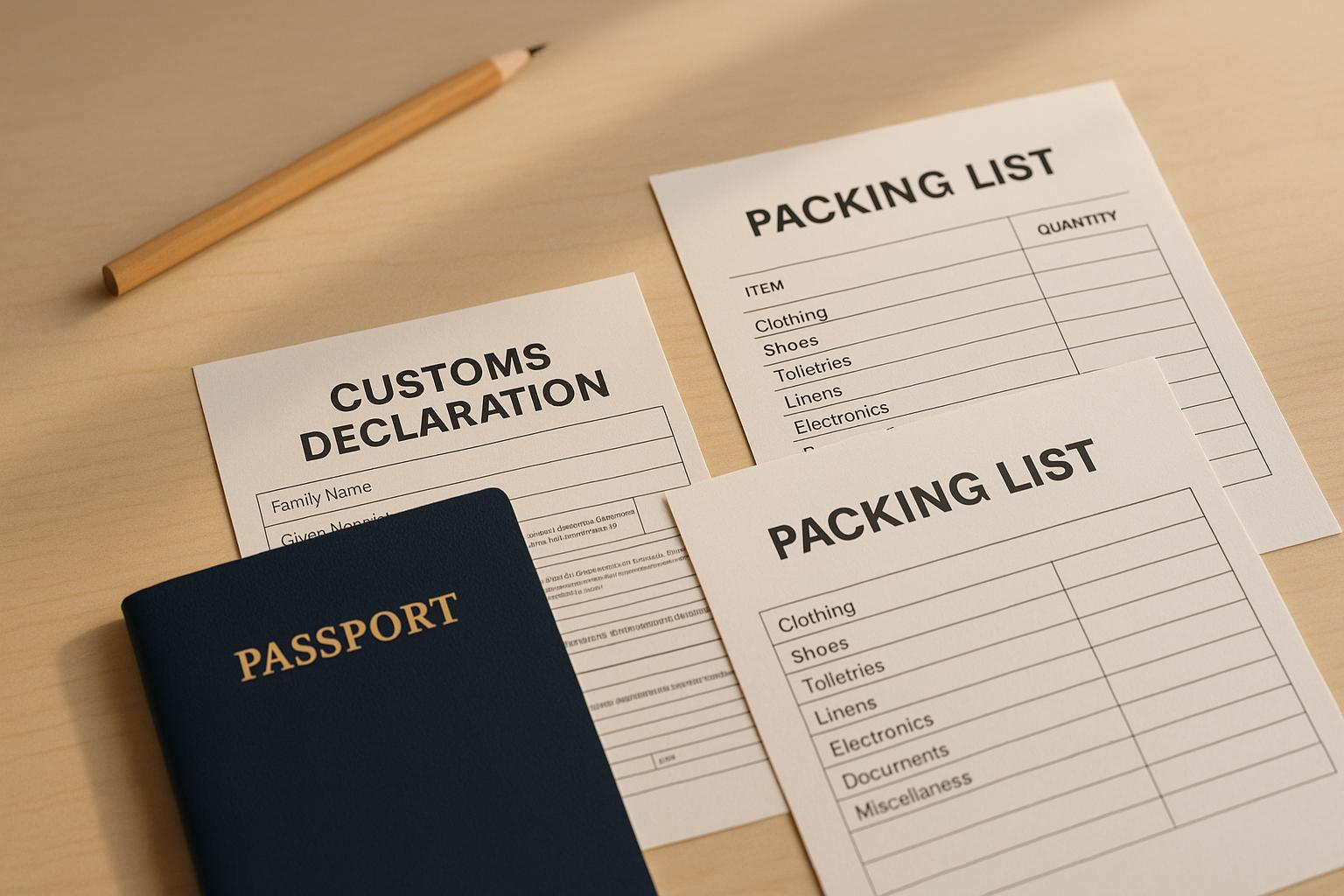
When moving internationally, having the right documents is non-negotiable. Missing or incorrect paperwork can lead to delays, fines, or even confiscation of your belongings. Here's what you'll need:
- Passport and Visa: Ensure your passport is valid for at least six months beyond your move date and secure the correct visa.
- Customs Declaration Forms: Each country requires specific forms to declare your shipment's contents. For example, the U.S. uses CBP Form 3299.
- Detailed Packing List: Include item descriptions, quantities, and values. For high-value items, provide receipts or appraisals.
- Bill of Lading or Airway Bill: This shipping document is essential for customs clearance.
- Additional Documents: Proof of residence, Power of Attorney (if using movers), pet import records, and certified translations for non-English documents.
Pro Tip: Keep both digital and physical copies of all documents. Store digital files in secure cloud storage and carry physical copies in your hand luggage.
Avoid common mistakes like incomplete forms, undeclared high-value items, or shipping prohibited goods. Professional movers can help navigate customs requirements and reduce risks. Platforms like ConsumersAdvisors.com connect you with licensed movers who specialize in international relocations, ensuring a smoother process.
Move Abroad Checklist | How To Prepare For Your Move Abroad
Required Documents for International Relocations
Getting your paperwork in order is a crucial step in ensuring a smooth international move. Each document plays a role in clearing customs, and having everything ready can save you both time and money - sometimes by weeks and hundreds of dollars.
Passport and Visa
Make sure your passport is valid for at least six months beyond your planned arrival date. Additionally, secure the appropriate visa for your situation - whether it’s for tourism, work, or study. Aim to check these details at least 90 days before your move to allow time for renewals or applications.
On top of that, you'll need to complete the necessary customs declaration forms to detail the items you're shipping.
Customs Declaration Forms
Customs declaration forms outline the contents of your shipment, helping authorities determine if your items qualify for duty-free entry and ensuring prohibited goods aren't included.
For example, U.S. CBP Form 3299 is required when importing used household goods and personal belongings into the United States [7][8]. This form includes detailed information about your shipment’s contents, their value, and your eligibility for duty-free treatment.
Every country has its own version of these forms, and the requirements can vary widely. Some forms must be submitted electronically before your arrival, while others are filled out upon entering the country. Your moving company or customs broker can guide you on the specific forms needed for your destination.
Detailed Packing List and Inventory
A thorough packing list is essential, providing clear descriptions, quantities, and values for every item. This helps customs officials process your shipment efficiently and reduces the chances of delays.
Be as specific as possible. Instead of listing "clothing", break it down: "10 shirts, 5 pairs of jeans, 3 winter coats." For high-value items like electronics, include details such as serial numbers and model information. This level of detail minimizes inspection delays and ensures a smoother customs process.
Whenever possible, include purchase receipts for newer items. Items bought within the last year may require proof of purchase to confirm their declared value. Keep digital copies of these receipts organized by category to streamline the process.
Bill of Lading or Airway Bill
Once your inventory is complete, you’ll need the Bill of Lading (for sea freight) or Airway Bill (for air freight). This document serves as a legal confirmation of your shipping agreement and includes critical details such as sender and recipient information, shipment contents, and transport terms [8].
This document is essential for customs to release your shipment. Without it, your belongings won’t be cleared, even if all other paperwork is in order. Your moving company typically handles the creation of this document, but you should keep copies for your records and have them easily accessible during the customs process.
Additional Required Documents
Other documents you might need include proof of residence (like a lease or utility bill), a Power of Attorney if you're using professional movers, pet import records (vaccination and health certificates, permits), and for families, child medical records and school transcripts. If any of these documents are in a language other than English, certified translations may be required. Preparing these supplementary documents ahead of time can help you avoid unexpected delays and fees.
According to industry data, about 30% of international shipments face delays due to incomplete or incorrect documentation [2]. Taking the time to gather and organize everything properly can go a long way in ensuring your move stays on track.
How to Organize and Protect Your Documents
Once you've gathered all the necessary paperwork, the next step is keeping everything organized and secure. Proper document management can make all the difference between a smooth customs process and unexpected, costly delays.
Digital and Physical Copies
Start by scanning all essential documents - like your passport, visa, customs forms, inventory lists, and legal or financial records - and saving them as high-resolution PDFs. Having both digital and physical copies ensures you're covered even if the originals are lost, stolen, or damaged during the move.
Store digital copies in secure, password-protected cloud storage that uses two-factor authentication. Make sure to label files clearly (e.g., Passport_JohnSmith_2025.pdf) for easy access when needed. For added security, encrypt sensitive documents and only share access with trusted individuals, such as your moving coordinator or close family members.
If you're traveling, mobile scanning apps can help you quickly digitize any additional documents. Use a password manager to keep your cloud account credentials safe, and check if your moving company offers secure portals for uploading documents.
To prepare for situations where internet access might be unavailable, download key files to your phone or tablet before traveling. This way, you'll have offline access at customs or border crossings. Combining these digital precautions with physical organization ensures you're ready for every checkpoint.
Safe Storage During Travel
While digital backups are essential, physical organization is just as important. Use a sturdy, waterproof travel folder with labeled sections for each type of document. Group documents by category - such as identification, customs paperwork, medical records, and legal agreements - for quick access.
Always keep this folder in your carry-on luggage. Never place critical documents in checked baggage, as they could be lost or delayed. Losing these papers could disrupt your plans significantly.
For added security, carry the originals and at least one set of certified copies in separate spots within your carry-on. If you're traveling with family, distribute copies among different members to reduce the risk of losing everything at once. Keep frequently used items, like your passport and customs forms, in an easily accessible pocket of your organizer.
Here's an example of how this strategy can save the day: An expat moving from the U.S. to Germany brought both digital and physical copies of their customs forms and certified translations. When their checked luggage - containing the originals - was delayed, the digital copies allowed them to clear customs and secure temporary housing without any delays[2].
Certified Translations
Certified translations are another key piece of the puzzle, especially when you're moving to a non–English-speaking country. Documents like birth certificates, marriage licenses, medical records, and legal agreements often need to be professionally translated and certified for customs or immigration purposes. These translations help officials verify your information quickly and accurately, avoiding unnecessary delays.
Check the website of your destination country's customs authority or embassy for specific requirements. Some countries provide lists of approved translation services or outline which documents need certification. Since processing certified translations can take several weeks, it's a good idea to start this process 60–90 days before your move.
Certified translations typically cost between $20 and $50 per page. While this might seem like a significant expense, it's a small price compared to the potential costs of customs delays or denied entry.
Store digital copies of these translations alongside your other important documents in your secure cloud storage. If you're working with professional movers, many offer recommendations for trusted translation services or can even handle the process for you. Websites like ConsumersAdvisors.com can help you compare reputable movers who provide full document management support, including assistance with certified translations and secure handling of all your paperwork throughout the relocation process.
sbb-itb-be87134
Common Documentation Mistakes to Avoid
Even with well-organized documents, certain mistakes can still throw a wrench into your customs clearance process. Did you know that documentation errors account for 30% of customs delays? These errors can lead to fines, extended holds, or even the seizure of your shipment[3]. By steering clear of these common pitfalls, you can save yourself time, money, and unnecessary headaches.
Incomplete or Incorrect Information on Forms
One of the most common reasons for customs delays is incomplete or inaccurate paperwork. Simple errors, like a misspelled name, missing signatures, or an incomplete item description, can cause your entire shipment to be held up. According to U.S. Customs and Border Protection (CBP), incomplete or incorrect customs declarations are a leading cause of shipment detentions and fines[3].
For example, Customs Form 3299, which is required for importing personal belongings, often gets flagged due to errors. When this happens, customs officials may request additional documentation, delaying clearance by days or even weeks[1].
To avoid this, thoroughly review all forms before submitting them. Use official checklists provided by the customs authority in your destination country. If you're unsure about any section, seek guidance from a customs broker or your moving company. Many professional movers offer document review services to catch errors before they escalate into costly problems. Also, be specific on your inventory lists - avoid vague terms like "household items" or "personal effects" and provide detailed descriptions instead.
Prohibited or Restricted Items
Every country has a specific list of items that are either prohibited or require special permits to import. Shipping restricted items without proper documentation - or prohibited items outright - can lead to confiscation, fines, or significant delays[1][2]. Commonly flagged items include firearms, plants, food, cultural artifacts, and certain electronics[1][2][9].
To stay ahead, research your destination country’s prohibited and restricted items list well in advance - ideally 60 to 90 days before your move. For example, U.S. Customs and Border Protection provides an updated list of items that cannot be imported, and similar resources are available for other countries.
"Yes - most movers won't transport hazardous materials, perishable food, plants, pets, or high-value items like cash and jewelry. Always ask your mover for a full list so you can plan ahead." - ConsumersAdvisors.com[5]
It’s worth noting that the list provided by your moving company may not align with customs regulations. An item your mover agrees to transport might still be restricted or prohibited by your destination country. Always cross-check both lists to avoid surprises.
Undeclared High-Value Items
High-value items like jewelry, artwork, electronics, antiques, and collections must be clearly declared, often with supporting receipts or appraisals. Countries typically define "high-value" as items worth more than $500. Failing to declare such items can result in penalties or even the seizure of your shipment[1][2].
To meet customs requirements, keep detailed records of your high-value items. This includes purchase receipts, insurance appraisals, and photos documenting their condition. If you don’t have original receipts, consider getting a professional appraisal. These documents not only ensure compliance with customs but also serve as proof of value for insurance claims in case of loss or damage.
Keep in mind that many professional movers won’t transport extremely high-value items, such as large sums of cash, expensive jewelry, or irreplaceable family heirlooms. For these, make alternative arrangements, such as carrying them personally or using specialized shipping services with adequate insurance. These extra steps, combined with careful documentation, can help you avoid delays and protect your valuables.
| Common Mistake | Potential Consequence | Prevention Strategy |
|---|---|---|
| Incomplete forms | Shipment delays, fines | Review all fields, consult professionals |
| Missing details | Customs holds, extra costs | Double-check forms, use official checklists |
| Prohibited/restricted items | Fines, confiscation | Research regulations, remove restricted items |
| Undeclared high-value items | Penalties, shipment seizure | Declare items, provide receipts or appraisals |
Accurate documentation is the backbone of a smooth customs clearance process. Professional movers can be invaluable in this regard, offering services like document preparation, customs compliance guidance, and coordination with trusted carriers. For instance, ConsumersAdvisors.com connects you with licensed movers who specialize in international relocations, helping you navigate complex requirements and minimize risks of delays or complications at customs.
Using Professional Moving Services
Relocating internationally comes with its fair share of challenges, especially when it comes to handling intricate documentation and navigating changing customs regulations. This is where professional international movers step in, turning what could be a stressful process into a much smoother experience. Beyond just transporting your belongings, these experts handle customs compliance and paperwork with precision, ensuring everything is in order.
Benefits of Hiring Experienced International Movers
Professional international movers are your go-to for managing the complexities of relocation paperwork. They provide detailed document checklists, carefully review all forms, and ensure everything aligns with the regulations of your destination country [2]. A dedicated move coordinator is often assigned to oversee the process, ensuring accuracy and compliance at every step.
These movers stay updated on the latest customs regulations [2], which is invaluable when dealing with the ever-changing rules of international shipping. Their expertise minimizes errors, prevents common pitfalls, and ensures your shipment meets all local requirements. This significantly reduces the chances of delays, penalties, or shipment hold-ups.
In addition to handling documentation, professional movers work closely with customs brokers and destination agents to streamline the clearance process. Once documents are completed, movers forward them to authorized agents, who verify the details and pass them along to customs brokers. The destination agent then schedules the delivery of your goods and coordinates with you for a convenient release time [6].
For exports from the U.S. exceeding $2,500 per item, professional movers manage AES filings on your behalf [4]. Freight forwarders or carriers can handle these filings as long as you provide a letter of authorization and your tax identification number.
Statistics show that individuals who use professional international movers experience fewer customs-related delays and face lower penalties compared to those who manage the process themselves [2].
| Service Aspect | Movers | Self-Managed |
|---|---|---|
| Documentation Preparation | Complete checklists, form review, and compliance guidance | Research and prepare all documents independently |
| Customs Knowledge | Up-to-date regulations for multiple countries | Limited to personal research |
| Error Prevention | Professional review catches mistakes before submission | Higher risk of costly errors |
| Compliance Risk | Low – expert handling reduces delays and penalties | High – documentation mistakes common |
Using ConsumersAdvisors.com
If you're looking for an easy way to find reliable international movers, ConsumersAdvisors.com is a great place to start. This platform allows you to compare long-distance moving companies, read expert reviews, and get instant quotes. It highlights licensed movers with experience in international relocations, including those offering full-service packing, storage, and comprehensive customs and documentation support.
ConsumersAdvisors.com evaluates movers based on clear pricing, reputation, customer reviews, reliability, and safety measures, helping you connect with trustworthy providers [5]. By using this platform, you can quickly identify movers who specialize in handling the nuances of customs paperwork.
The site also simplifies comparing different moving options, ensuring you find companies adept at managing documentation and customs compliance. This is especially helpful as professional movers continuously monitor updates to customs regulations and provide guidance on new requirements, such as changes in prohibited items, duty calculations, or documentation standards [6]. When choosing a mover through ConsumersAdvisors.com, prioritize companies that offer end-to-end relocation services, including document preparation, customs clearance, and compliance with destination-specific requirements [2]. These comprehensive services ensure that your move is handled by professionals who understand the regulations of both your origin and destination, giving you peace of mind throughout the process.
Conclusion
Making an international move requires careful attention to documentation. In fact, over 60% of delays in international relocations stem from incomplete or incorrect paperwork, highlighting the importance of thorough preparation [2].
Key steps include ensuring your travel documents are up to date, creating a detailed inventory, completing customs forms accurately, and securing a bill of lading or airway bill. Double-checking every document can help you avoid costly mistakes like delays, fines, or even confiscations. It's also smart to organize both digital and physical copies of these documents - having backups can be a lifesaver if something gets lost or damaged during transit. This level of preparation lays the groundwork for a smoother, less stressful move.
When the paperwork feels overwhelming, teaming up with professional movers can make all the difference. Experienced movers are well-versed in current regulations, provide detailed document checklists, and can spot errors before they become major issues.
If you're looking for dependable international moving services, ConsumersAdvisors.com is a helpful resource. The platform connects you with licensed movers who specialize in international relocations. From expert reviews to instant quotes and services like document preparation and customs coordination, it simplifies the process. Choosing movers through this platform ensures you're working with professionals who understand both the paperwork requirements and the complexities of international shipping.
FAQs
What happens if I don’t have the right documents for an international move?
Moving internationally without the right documents can lead to serious headaches - think customs delays, fines, or even having your belongings denied entry. To avoid these issues, you’ll need to have key paperwork ready, including passports, visas, customs declarations, and detailed inventory lists.
If your documents aren’t in order, your items could be held up, confiscated, or hit with extra fees. Getting everything prepared and organized ahead of time helps ensure the customs process goes smoothly and keeps your move on track without unexpected disruptions.
What steps should I take to properly declare and document high-value items for customs during an international move?
When preparing for an international move, it's important to properly declare and document any high-value items. Start by putting together a detailed inventory list. Be sure to include thorough descriptions, estimated values, and serial numbers if applicable. Clearly mark these items as high-value, and gather any supporting documents you might have, such as receipts, appraisals, or insurance policies.
Let your moving company and customs authorities know about these items ahead of time. Additionally, consider getting an insurance policy specifically designed to cover high-value belongings. Having everything documented not only ensures you meet customs requirements but also helps prevent delays and provides added protection for your valuable items during the move.
How can I avoid common document errors that might delay my international move?
To avoid hiccups with your international move, it's crucial to ensure all your documents are accurate, complete, and current. Double-check that your passport, visa, and any necessary permits - like work or residence permits - are valid for the entire time you'll be living abroad.
Create a thorough inventory list of your belongings, and make sure all customs forms, shipping labels, and receipts are filled out correctly and align with the items you're shipping. It's also a good idea to research the specific requirements of your destination country, such as import restrictions or additional paperwork, to steer clear of unexpected issues at customs.
If you're feeling uncertain, reaching out to a professional moving company or customs expert can be a smart move. They can help spot potential problems early and ensure your paperwork meets both U.S. and destination regulations.